At the University of Michigan, we recognize our responsibility to manage the energy consumption associated with AI technologies. We are committed to accurately accounting for this usage as part of our Scope 3 emissions analysis and future goal-setting processes.
Addressing the energy demands of AI is not just a university issue—it is a societal one. As an institution, we aim to leverage AI in a responsible manner, aligning our actions with our broader climate action goals.
Generative AI @ U-M
U-M is a world leader in providing equitable and responsible AI access to our community. Responsible AI includes managing the environmental impact of our generative AI platform.
U-M elevated sustainability considerations through our choice of cloud hosting partner. We chose to host our AI services on Microsoft Azure, a cloud platform with aggressive environmental sustainability goals.
In their 2025 Environmental Sustainability Report, Microsoft notes that they aim to be carbon negative by 2030 (source). This aligns with U-M’s own 2040 Carbon Neutrality goals (source).
AI requires significant energy consumption. One essential benefit of developing our own generative AI platform is that it allows our university to more accurately track AI usage on campus. This enables us to better understand and quantify our energy expenditures related to AI usage than with commercial AI tools, and use that insight to iteratively shape our sustainable goals and practices.
This “act locally, think globally” approach means that U-M can approach our sustainability efforts from a more informed and proactive position.
To give you an idea of our platform’s energy usage, currently, the U-M AI platform receives about one million queries every month. It has been estimated that a single AI query consumes around 0.002 kilowatt hours (kWh) of electricity (source). Using that standard, we can estimate that our AI platform is using approximately 2,000 kilowatt hours every month or 24,000 kilowatt hours every year.
For comparison, according to the U.S. Energy Information Administration, the average U.S. household consumes about 10,500 kilowatt hours every year (source).
That means U-M is able to provide a suite of first-of-their-kind AI tools for all of our students, faculty, researchers, and staff for the energy equivalent of a little more than two average U.S. homes per year.
Encouraging Responsible Use of AI
U-M is committed to making sure our community understands the real-world impact of using AI. While these tools support creativity, learning, and productivity, it is important to recognize that each AI query, whether text-based or image-based, consumes more energy than a traditional search engine query. For instance, a single search engine query uses approximately 0.0003 kilowatt-hours (kWh) of electricity, whereas an average GPT query consumes about 0.0029 kWh—nearly ten times more energy. The energy demands are even higher for AI image generation. Creating a single AI image can use up to 2.9 kWh per 1,000 inferences, which is roughly equivalent to fully charging a smartphone.
Being mindful of how and when we use these tools is one small but meaningful way to reduce our collective environmental impact. At U-M, we invite our community to help us amplify our sustainability efforts by making informed, intentional choices in their use of AI.
AI and Sustainability: Education
AI has already become a significant aspect of sustainability discussions across university campuses. While it may currently appear to some as a specialized concern, its growing impact on energy consumption and the potential benefits it offers for sustainability education and research make it an increasingly relevant topic.
At U-M, we remain dedicated to exploring how AI can enhance academic outcomes while we work to mitigate its environmental impact responsibly. We look forward to engaging the broader campus community in these discussions to collectively advance sustainable AI practices.
What Comes Next
At U-M, our goal is to be at the forefront of AI innovation while always remaining responsible global citizens. As we push the boundaries of what AI can achieve, we are equally dedicated to ensuring that the environmental footprint of these technologies is responsibly managed and reduced over time.
Engaging with Students
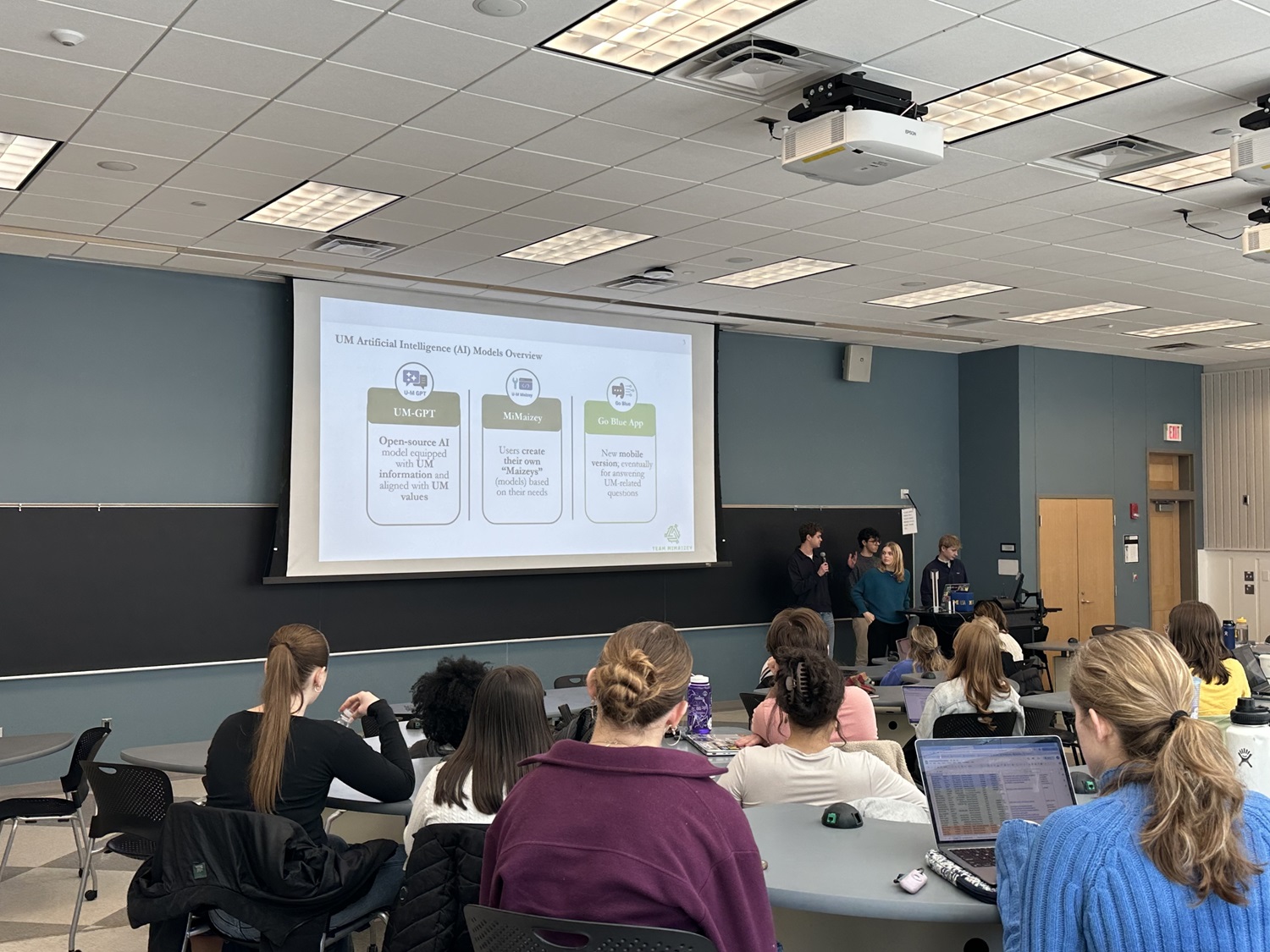
In Winter Semester 2025, our ITS Emerging Technology team worked with students in the university’s ENVIRON 391: Sustainability & the Campus course to better understand how students currently use AI and their understanding of its environmental impacts. In collaboration with ITS stakeholders, the students authored a report titled “Key Takeaways and Recommendations for Artificial Intelligence Usage at the University of Michigan.” One of the report’s recommendations was for the university to “prioritize long-term sustainability through consistent sustainability transparency and accountability.”