

Improve the way we serve the U-M campus by providing proactive, laser-focused customer service.
The following accomplishments represent how departments within Information and Technology Services (ITS) successfully met this vital 'Area of Focus.'
Click on an ITS department title to view all their accomplishments for fiscal year 2024 (FY24).
Digital Accessibility Tools
This year, ITS launched Grackle and Panorama to enhance digital accessibility at U-M. Grackle empowers users to ensure content accessibility in Google Docs, Slides, and Sheets. Meanwhile, Panorama provides a toolset in Canvas, offering data dashboards and resources for instructors and students to create and access accessible content. These tools facilitate the university's compliance with accessibility standards.
Procurement Updates
ITS collaborated with ECRT, Central Procurement Services, and the OGC to update procurement processes so that digital products and services meet accessibility requirements. These updates revise contract language, enhance user resources, and embed accessibility priorities into U-M's procurement strategy. ITS aligns its internal procedures to support long-term success and ensure compliance in acquiring accessible technologies.
Communication and Awareness
U-M revamped its main Digital Accessibility website to improve user experience and serve as a hub for accessibility knowledge. We reached key audiences and raised awareness about the Digital Accessibility Strategic Initiative through targeted emails, social media, and presentations. We launched a Communications Toolkit to enable unit communicators to effectively spread accessibility messaging across the university.
Community and Culture Building
We strengthened the Digital Accessibility Liaison network to provide consistent central updates and gather feedback from units. By fostering communities like Unit Scan Coordinators and instructional support staff, we enhanced support for web accessibility and Canvas integrations. These efforts set the stage for cultural change and long-term success in making U-M more accessible.
Research and Development
ITS focused its research and development efforts on emerging solutions for digital documents and media formats. This proactive approach prepares us to adopt state-of-the-art technologies to enhance accessibility further. By staying current with these advancements, we remain well-positioned to continuously improve accessibility solutions at U-M.
Strategic Initiatives and Compliance
With the launch of the Digital Accessibility Strategic Initiative, U-M aims to meet updated accessibility regulations by April 2026. We have engaged the entire university community through comprehensive efforts, including a Provost’s message and new accessibility tools. Additionally, we initiated an RFP for a web accessibility scanning solution to support compliance and track ongoing progress.
Marketing and Communications
ITS Administration & Operations
ITS Marketing and Communications supported dozens of project communications across the student, faculty, staff, and alumni communities, including service launches and retirements. They also led the campus-wide rollout of the Go Blue AI App. The team produced high-impact events such as Welcome to Michigan, Festifall, Researchpalooza, end-of-semester Power Up celebrations, New Faculty Orientation, and multiple GenAI showcases. They spearheaded the development and launch of the Digital Accessibility Strategic Initiatives’ communication strategy across all U-M campuses. Finally, they created an AI disclosure statement to ensure transparency for all ITS-produced content.
Facilities
ITS Administration & Operations
The ITS Facilities team completed a series of strategic infrastructure improvements to modernize and future-proof key campus spaces. They oversaw a comprehensive renovation of the third floor of the Academic Services Building (ASB) and relocated the MiWorkspace Depot from the Central Student Services Building into ASB for improved accessibility. At Arbor Lakes, they replaced the roof of Building 2 and upgraded card readers to enhance building security. These projects ensure ITS facilities remain innovative, secure, and aligned with U-M's commitments to sustainability and user experience.
System Operations
ITS Administration & Operations
The ITS System & Operations teams delivered several high-impact infrastructure and innovation milestones. The Server Virtualization team deployed a redundant virtual cluster within the Virtualization Service, empowering the Networking team to monitor U-M Net campus network more nimbly and comprehensively. The Virtual Desktop Infrastructure team built and launched a FIPS-compliant MiDesktop cluster for the Inter-University Consortium for Political and Social Research, ensuring sensitive data is protected with NIST-approved cryptographic standards. And the Cloud Services team collaborated with Google’s Rapid Innovation group, Nerdery, and Ross School of Business professors to pilot a Virtual Teaching Assistant: an AI chatbot powered by Google’s Gemini, deployed via Terraform, secured with new domain and certificate management, and balanced through a cross-project load balancer. This innovative service — set to expand to 9,000 students across 72 courses and 26 institutions over the next two years — demonstrates ITS’s commitment to leveraging cutting-edge cloud and AI technologies to enhance teaching and learning.
Core Applications Team
ITS Administration & Operations
The ITS Core Applications team transformed ITS monitoring, service delivery, and security. The team migrated all Nagios users to a fully prepared Zabbix service — retiring legacy tooling while enhancing monitoring coverage — and simultaneously rolled out expanded customer self-service capabilities. Behind the scenes, the group boosted database performance to eliminate capacity bottlenecks, instituted standardized change-control processes, and reviewed the disaster-recovery plan to ensure resilience. In partnership with the PMO, the team integrated the Major Incident group into OpsGenie for streamlined alerting, launched a Service Center CTOP internship to share expertise and accelerate ticket resolution, and fortified email hosts by blocking malicious connections. Finally, the group deployed an ITAR-compliant GitHub instance to support export-controlled development environments, securing the university’s most sensitive codebases.
MiServer and MiDatabase
ITS Administration & Operations
The ITS MiServer and MiDatabase team successfully upgraded over 100 MiDatabase servers from MySQL 5.7 on RHEL 7 to MySQL 8.0 on RHEL 8 — collaborating with individual application owners to ensure full compatibility and minimizing downtime through robust database replication — while also hosting the BTAA DBA conference in May to foster community engagement among database professionals. In parallel, the team modernized its MiServer Windows Server Security Standards by introducing automated update hardening on all newly managed systems (with a retrofit approach for existing servers) and streamlining policy enforcement and vulnerability management. This initiative drove compliance to over 90% against both CIS-CAT and DoD STIG level 1 and 2 benchmarks — well above the original 80% target — thereby solidifying a stronger, more transparent security foundation.
Organizational Development Team
ITS Administration & Operations
The ITS Organizational Development team achieved Qualified Education Provider status for its Organizational Change Management (OCM) training — enabling certification candidates to save up to $4,500 — while introducing team-building, change-management, and facilitation services alongside networking events to strengthen performance and connectivity across units. They also launched an “OCM Backstage” toolkit page to support individuals navigating the people-side of change, and debuted five professional development courses — OCM Levels 1–3, Communicating Effectively (Straight Talk), Crucial Conversations for Accountability, Crucial Influence, and Giving & Receiving Feedback — all of which garnered satisfaction ratings between 85% and 100%.
Finance Accomplishments
ITS Administration & Operations
With a $159 million budget, the ITS Finance department helped launch AI capabilities through financial modeling, establishing billing procedures for ITS with this innovative technology. The team created a TeamDynamix financial billing portal for ITS Recharge Rates, which accounted for approximately $31 million in FY25 billings. They also managed financial aspects for major incidents and future planning needs. In FY25, the Finance team also saw the completion of several major projects, including the ARC Research Computing Support & Data Center Upgrade project: a 7 year, $30 million capital project; and the Digital Asset Management Project: a 2 year, $1 million capital project. These projects are being wrapped in the FY25 budget, accounting for some of the $157 million in actual costs, $2 million better than the budget.
HR Accomplishments
ITS Administration & Operations
The ITS Human Resources team saw growth and retention in FY25. The HR team hired more than 60 new staff, supported 20 staff retirements, and maintained a 91% retention rate. A part of that effort was revamping and relaunching the ITS HR Orientation for new employees, creating and facilitating the new annual Performance Management training, and refining the immigration policies for ITS recruitment procedures. Current employees can participate in the Change Management job series at the university since HR’s partnership with the Compensation and Classification team.
ARC Research Purchased Hardware (ARPH)
ITS Academic Research Computing (ARC)
Faculty Owned Equipment (FOE) underwent a service refresh, which included a name change: ARC Research Purchased Hardware (ARPH)–reflecting an improved support for systems external to ARC, purchased by researchers for specific needs.
To offer greater flexibility and value to users, ARC launched two distinct integration options for adding hardware to ARC’s high-performance computing clusters:
- Condo model: research-purchased hardware is exclusively available to the researcher, offering greater customization for performance and storage.
- Timeshare model: research-purchased hardware becomes part of an existing shared pool with shared accessibility, offering burst capacity, better protection against hardware failures, and the opportunity to receive HPC credit.
Responsible, Secure Management of Human Genomic Data
ITS Academic Research Computing (ARC)
Starting in January 2025, the National Institutes of Health (NIH) announced an update regarding data management and access practices of human genomic data, introducing changes focusing on modernizing security standards and aligning with frameworks set forth by the National Institute of Standards and Technology (NIST).
Currently, the Secure Enclave Services, a virtual server environment operated by ARC, is the only service across campus that meets these updated requirements, providing U-M researchers who work with genomic datasets with high-performance, secure, and flexible computing environments. To further support researchers and data security, ITS seeks to expand campus offerings that meet security requirements for other sensitive data classifications, such as Controlled Unclassified Information (CUI) and the Cybersecurity Maturity Model Certification (CMMC) from the U.S. Department of Defense.
ARC Website Migration
ITS Academic Research Computing (ARC)
Last summer, the ARC website received a complete glow-up with a redesign more closely aligned to ITS branding standards. Behind the scenes, improvements were made to the overall functionality and accessibility of the site, reducing potential barriers between ARC’s services and U-M researchers who would benefit from them. There’s even a new ARC Maizey in the mix, an AI chatbot available 24/7 to field inquiries or help researchers navigate which ARC service would best fit their needs.
UMRCP
ITS Academic Research Computing (ARC)
The U-M Research Computing Package is a comprehensive suite of resources, offering high-performance computing hours, secure enclave services, replicated storage, and extensive archive capacity at no cost to members of the U-M community. Designed to meet the diverse needs of researchers, instructors, student teams, including Michigan Medicine, this package demonstrates ARC's dedication to nurturing an innovative research community.
A Trusted Partner: Expert IT Project Management Guidance for Units
This year, several IT Project Managers from the ITS PMO provided expertise to campus units including the Office of Enrollment Management, the Center for Campus Involvement, the President’s Office, the Office of National Labs, and more. Their guidance included establishing and managing vendor relationships, selecting project management tools, and coordinating visits and press releases with executives for planning and designs for in-progress initiatives. A senior project manager embedded in the Office of Enrollment Management (OEM) executed AI initiatives that align with OEM’s divisional goals, such as developing and refining an AI tool that automates the mentorship matching process for the Office of New Student Programs and developing an AI-driven tool summarizing teaching evaluation comments for faculty.
The ITS PMO has also been able to lend expert project managers to lead projects at Michigan Medicine and the U-M School of Information. One senior project manager successfully implemented an enterprise platform to streamline clinical and supply chain activities, completing key integrations with MiChart by March 31, 2025, and fostering strong collaborations with ITS Fin, Periop Informatics, Supply Chain Management, and clinical leadership. Another project manager facilitated the implementation of the CourseDog Curriculum Management application at the U-M School of Information, enhancing academic operations to streamline scheduling, curriculum management, and faculty workload logistics, thereby improving administrative efficiency and supporting student success for both students and faculty.
These collaborations enhance ITS’s role as a trusted partner by ensuring project success through specialized expertise, benefiting units with better navigation of complex challenges, and leading to more efficient IT solutions. From strategic AI development to enterprise platform integration, the ITS PMO consistently delivers targeted support, securing improved outcomes across the university.
PMO: Service Excellence and Beyond
This year, the PMO continued to organize and work on internal and external audits, with 36 internal audit engagements for the year. This crucial function strengthens the alignment to “One ITS” strategic objectives. It reinforces the organization’s commitment to Service Excellence by driving continuous process improvements that heighten the quality and efficiency of ITS services.
In addition to leading projects that follow the Service Lifecycle and often directly result in organizational process improvements, the PMO partners with many areas of ITS to deliver processes critical to creating consistency and improving service quality and effectiveness. The most significant of these is the ITS Service Lifecycle (New Service, Major Service Change, and Retirement) where the PMO supports, collaborates, and consults with Service Owners and Managers in completing the process steps. The PMO Operations team continued to train new Service Owners & Service Managers into the Service Lifecycle. As well as administer and support the Project Management Module in TeamDynamix and provide it to ITS as well as campus unit users.
Additionally, the PMO supported and continued improvements this past year for:
- ITS Services Roadmap Reviews
- Project Communications and Org Change Management
- Updated Service Checklist and Charter improvements
PMO Projects and Strategies for FY2025
The PMO played a pivotal role over the past year by committing resources and providing leadership in numerous strategic initiatives across U-M. The PMO's contributions have been integral to the formulation and planning of critical strategies that underpin the future goals and objectives of ITS. Moreover, the PMO has enhanced the organization’s agility, enabling it to swiftly respond to and effectively manage rapidly emerging and evolving strategic demands, helping to ensure that priorities can be addressed in a timely and effective manner.
Notable FY2025 Projects Included:
- Digital Accessibility campus service
- Cybersecurity enhancements
- Wolverine Identity (SSO required)
- IT Transformation
- Los Alamos National Lab (LANL) partnership to build a new computing facility
- Controlled Unclassified Information (CUI)
DART and CRM Implementation and Upgrades
ITS Enterprise Application Services
- Salesforce Education Cloud: The ITS Enterprise Salesforce Org service upgraded to a new Salesforce platform called Education Cloud. The platform architecture has features designed for an Education base, and we are Education! The goal is to use the innovative features Salesforce has delivered in Education Cloud and move away from custom development.
- Implemented a number of DART enhancements including:
- Updates to recognition credits and adding new special recognition credit attributes to improve data integrity and reporting accuracy.
- Introducing a new method for processing online payment transactions, directly supporting the Office of University Development’s goal of enhancing the donor digital experience.
- Improving tribute management functionality, making it easier for users to manage and acknowledge tribute gifts within the system.
Human Capital Management
ITS Enterprise Application Services
- Remote Worker Integration in PeopleSoft: Automated the process for remote work agreements within M-Pathways, facilitating seamless collection and approval through self-service workflows. This also provides university-wide data on employee locations.
- Earned Sick Time Act (ESTA) Project: Executed a complex rollout to align with legislative changes and university leave practices.
Supply Chain and Financial Operations
ITS Enterprise Application Services
- LIMITS Implementation: Rolled out in all U-M Hospital Operating Rooms, further enhancing U-M’s supply chain management through advanced enterprise tools.
- Check Printing: Outsourced this function to streamline operations and optimize resource use.
- Worldpay Merchant Exceptions: Developed a specialized process for handling exceptions, increasing financial flexibility.
- Chrome River (Emburse Enterprise) Expense Management: Supported the implementation of a new expense management tool, responding to the demand for better integration with new travel systems and improved user experience.
Student Administration Enhancements
ITS Enterprise Application Services
- Official Transcripts Ordering: Alumni can now order transcripts online without needing U-M login credentials, removing the hassle of paper forms. Students benefit as well, with the ability to send transcripts electronically to services like LSAC and NursingCAS, ensuring quicker delivery and a smoother process. These enhancements have led to a 70% drop in transcript-related TeamDynamix emails and a 30% decline in phone inquiries, significantly easing our department's workload. Additionally, individuals who graduated before fall 1993 can now receive PDF transcripts, further reducing paper mailings. Those who have used the service have expressed appreciation for the faster and more convenient electronic options.
- Admissions Prospective Student Record Cleanup: Reconciled more than 200,000 prospect records, thereby improving system performance and reducing personal data access, aligning with data protection principles.
- SPACES (SPecialized Academic Classroom & Event Scheduling) Implementation: Implemented new system supporting over 12,000 class sections and 11,000 events, ensuring efficient resource allocation and scheduling.
Research Administration Advancements
ITS Enterprise Application Services
- Framework Upgrades: Upgraded two critical systems to support enhanced research capabilities.
- AI for Awards: Conceived and implemented AI application for award processing, reducing direct data entry and related staff time for ORSP.
- eResearch Replacement Systems Recommendation Project: The current eResearch platform is being phased out by the vendor by 2031. In the planning phase we are exploring various strategic options to develop a roadmap that allows for a smooth transition with minimal disruption.
Launching Higher Ed’s First Mobile AI App
Less than a year after introducing U-M’s custom set of AI tools, the first of its kind in higher education, the Emerging Technology team set their sights on the next milestone: an AI mobile app provided to the campus community at no cost.
Go Blue, the powerful mobile AI app, was launched in February 2025. Providing real-time, U-M specific information such as dining hall menus, bus schedules, and fun facts, Go Blue enhances life on the Ann Arbor campus for students, faculty, and staff, all while providing simultaneous access to OpenAI’s GPT4 model.
The first release of Go Blue is a great starting point in exploring what we can build at U-M. As the Emerging Technology team continues to add data sources and functionality to the app, it will become an even better campus companion.
Help us shape the future of AI at U-M by joining the Go Blue Beta Testing Team
Maizey and Canvas: the Perfect Match
As generative artificial intelligence became more integrated with campus life in FY2025, we saw instructors and students engage with U-M's tools more than ever. The U-M Maizey LTI Connector was used to create over 500 AI tutors, accessible around-the-clock, with access to course materials provided in Canvas.
The LTI Connector turns a few clicks by an instructor into a virtual teaching assistant with access to lecture slides, recordings, and more. Approximately 5,500 students engaged with course-custom Maizeys to ask questions, create study guides, and more deeply understand the material outside the classroom and office hours.
Maizeys created using the U-M Maizey LTI Connector are even accessible to students through Go Blue. When the student signs in to the app, the Maizeys created in Canvas are automatically connected so they can even study on the go!
More Engagement Than Ever
More
FY2025 saw an increase in the number of wolverines engaging with U-M's AI services. The total number of users of U-M GPT surpassed 43,800, increasing by over 30%, and over 5,800 unique Maizey projects were created. These numbers are not only a testament to AI’s increasing popularity but to the 12 releases of new tools and features made by the Emerging Technology team. With each release, improvements to the functionality of U-M GPT, Maizey, and Go Blue made engaging with U-M's custom AI tools more effective and accessible for everyone on campus.
U-M GPT used 102,319,599,639 tokens, which is equal to about 76.7 billion words — that’s enough words to repeat Taylor Swift’s discography over 900,000 times (vault tracks included), fill enough sheets of paper with 12pt font, when laid end to end, to circumnavigate the globe with 2,000 miles to spare, or over 1.5 million copies of the Dune and Wicked screenplays combined — talk about holding space, it’s time to call ARC for an increase in storage!
Continuing to Enhance Privacy at U-M
ITS Information Assurance & Office of Privacy
The ITS Office of Privacy and the Office of the Vice President for Communications (OVPC) released a new consent and preference management integration for U-M websites that accommodates the university’s complex, decentralized web environment and allows for easy integration and the ability to support non-umich.edu domains. The solution meets compliance requirements and demonstrates the university’s commitment to protecting the privacy of its community members and visitors.
In FY25, the Office of Privacy remained focused on broad outreach and education. Many U-M community members and guests attended this year’s Data Privacy Day keynote event on January 28, 2025, which featured a presentation by Prof. Sauvik Das on ‘Privacy in the Age of AI,’ and an in-depth conversation with UMSI Prof. Florian Schaub.
Following the success of ViziBLUE, the Office of Privacy debuted another innovative privacy tool this year. Privacy Portraits is a question-based, fun way to find out what sort of privacy persona you are and to learn about best practices selected just for you.
Supporting a Credible, Implementable, Enforceable, and Sustainable IT Policy Environment
ITS Information Assurance & Office of Privacy
In December 2024, the ITS Office of Privacy released a new IT standard and comprehensive guidance related to protecting university-owned systems, Endpoint Security Administration (DS-23). The standard formalizes guidance around implementation of enterprise-enhanced endpoint protection, adherence to the principle of least functionality, and maintenance of the inventory of university-owned systems, and helps units meet requirements around protecting our institution’s valuable digital assets.
In February 2025, the Office of Privacy published an important revision of the IT Standard on Network Security (DS-14) that introduces measures that further protect the university’s valuable digital assets and data, while continuing to support open access to resources across a diverse academic environment.
The team also developed a new self-service tool to help faculty and staff classify the data they are working with against the U-M data classification levels. This tool provides non-dispositive guidance to help plan for working with and protecting sensitive data.
Enabling Broad Training and Effective Engagement
ITS Information Assurance & Office of Privacy
In September 2024, the ITS Office of Privacy delivered an update to the required training for ITS staff. The new Data Protection for ITS course consolidates multiple courses on data protection, resulting in a comprehensive 30-minute data protection course that is streamlined, engaging, and accessible. A version of the course was made available to Unit IT and several organizations, such as Student Life IT, have successfully adopted it as a requirement for their staff.
In April 2025, the team released a new DCE101: Cybersecurity and Data Protection at U-M training course. The course provides practical data protection guidance and cybersecurity awareness for faculty and staff across all U-M academic campuses in a modern, engaging, and accessible format.
The Office of Privacy is also working to deliver role-based experiences and resources. Launched in March 2025, the Safe Computing for Students page provides a one-stop shop for students needing quick access to information about scams affecting U-M students, tips for staying safe online and protecting their privacy, and guidance on how to report phishing. The page is featured in new-student orientation materials.
Praise for the New Trainings
“Wow! It’s so good! . . . the best example of this type of training I’ve ever seen.”
– Anonymous U-M Staff member
“[An] excellent blend of detail and general information, which supports its objective,” and “was actually kind of fun!”
– Nigel Melville, associate professor of technology and operations at the Ross School of Business
“Excellent….All of the specific examples around phishing were super helpful.”
– Mike Daniel, chief operating officer at the Center for Academic Innovation
Standardizing Campus Security and Vulnerability Management with CrowdStrike and Tenable
ITS Information Assurance & Office of Privacy
As part of an initiative to reduce security risks to university systems, ITS Information Assurance (IA) replaced the Center for Internet Security (CIS) hardening tool with features offered by the already deployed capabilities built into the CrowdStrike Configuration Management Tool and Tenable. Removing manual CIS steps allows greater machine coverage and faster ongoing secure configuration checks against known baselines. This makes it easier for campus units to identify misconfigurations in their systems.
IA scans campus networks for vulnerabilities monthly, and units can choose to perform scans more often. A few times a year, IA audits for extremely critical vulnerabilities that have not been patched and are currently being exploited. Units with these vulnerabilities are given one month to patch their machines, or IA will quarantine their machine using CrowdStrike.
IA has also made a Web App Scanning feature from Tenable available to units as a self-service tool. Web App scanning allows a web application to be scanned to identify coding issues that may result in security concerns. By making this self-serve, units can scan their homegrown web apps at any time, for example, before they deploy new code changes to production.
Additionally, IA partnered with the central ITS Cloud team to deploy Tenable Cloud Security as its primary tool for monitoring cloud systems like AWS, Azure, and GCP, helping to spot and fix problems quickly. Tenable complements CrowdStrike Falcon, and with the addition of the Falcon Complete service, gives U-M and our partners at CrowdStrike the ability to detect and quickly respond to threats to our IT systems and data. Together, the two systems give U-M exceptional proactive, prevention, and response capabilities, and provide unit IT staff with access to information they can use to protect their unit and U-M.
Strengthening Cybersecurity Preparedness with Collaboration and Integration
ITS Information Assurance & Office of Privacy
In FY25, ITS Information Assurance (IA) created a tool to use Michigan Intelligence for Threat Negation (MITN) security data with Cloudflare, a market leader in the website Distributed Denial of Service (DDoS) protection space. This helps the MITN repository better manage web security and reduce false alarms.
To further enhance the university’s cybersecurity infrastructure, the IA team established two working groups: disaster recovery and vulnerability management.
- The Disaster Recovery Working Group focuses on operationalizing disaster preparedness within ITS. They coordinate with various departments and stakeholders to ensure an integrated and consistent approach to disaster recovery across ITS, including performing annual tabletop and failover exercises.
- The Vulnerability Management Working Group brings together representatives from major units across all three U-M campuses. This new touchpoint gives each group a direct voice, lets IA surface and resolve Tenable issues in real time, and keeps service direction tightly aligned with evolving campus requirements.
GenAI Workshop Series
Building on a successful launch from FY24, Teaching & Learning offered a comprehensive series of Generative AI workshops throughout the year, delivering 80+ workshops to 1,689 participants. Adapting to participant feedback, these sessions adopted a new format and expanded the range of topic areas to meet the varied interests and needs of instructors, staff, and students.
To complement these workshops, participants were offered three newly developed GenAI badges through the Canvas Credentials program, allowing them to showcase their new GenAI proficiencies on platforms such as LinkedIn.
Alongside the workshop series, the team also introduced the self-paced course, “Teaching with GenAI,” which has had over 300 participants to date.
U-M Maizey-Canvas LTI
To facilitate the integration and usage of GenAI in the digital learning environment, Teaching & Learning released the U-M Maizey LTI tool for Canvas, an integration that enables instructors to easily create an “AI tutor” — a chatbot available to students 24/7, powered by Maizey and customized with course materials to deliver real-time guidance, personalized learning, and streamline academic processes. This integration aims to reduce the strain on instructor resources arising from repetitive inquiries, limited hours of access to academic support, and catering to various learning styles by using AI. To date, the Maizey-Canvas LTI has supported over 400 courses. In April, the Maizey-Canvas LTI received external recognition as a finalist for the 2025 1EdTech Learning Impact award.
To further the adoption of this integration, Teaching & Learning collaborated with the Emerging Technology team to host a series of ‘Make a Maizey’ workshops, starting in December 2024. These in-person clinics encouraged instructors, faculty, and other academic staff to drop in and work one-on-one with team members to create their own Maizey for their Canvas courses, regardless of their skill level with AI. The teams have hosted six workshops to date to a growing number of participants and are planning to increase the offerings in the fall semester.
Network and Connectivity Enhancements
- Enhanced 5G Connectivity: The university worked with mobile providers to significantly boost the capacity and speed of 5G service, enhancing smartphone communication across campus. This initiative included upgrades at Michigan Stadium, providing faster data speeds and more reliable calls during events.
- Comprehensive Campus and Off-Campus U-M Net Upgrades: The team migrated to a new backbone network architecture across 69 buildings, and also greatly increasing WiFi coverage and capacity. Off-campus, they introduced U-M Net Hotspot to deliver robust internet access in areas lacking traditional infrastructure.
- Enhanced Security and Network Expansions: The team installed new firewalls across several university buildings to improve network security. They also expanded the fiber optic network and streamlined the approval process for network extensions. 79 Distribution Layers and 958 Access Layer switches were upgraded in Ann Arbor, ensuring over half of the 216 buildings on campus now have at least 100 gigabit per second network connectivity. Buildings were prioritized based on imminent research needs, known bandwidth bottlenecks, and the end-of-life date of the existing network switches.
Communication System Upgrades
- Modernized Phone System: The ITS Infrastructure team transitioned Flint and Dearborn campuses to Zoom Phone, replacing outdated systems to enhance call quality and reduce costs. This modernization improved communication efficiency for faculty, staff, and students.
- Upgraded Call Centers: The team upgraded university call centers to Amazon Connect, leveraging modern, scalable technology to improve customer service. This transition enabled quicker response times and personalized interactions, enhancing user experience.
Safety and Reliability Improvements
- Emergency Phone Restorations: The team restored emergency phones to good working order, ensuring these critical devices remain operational to maintain campus safety and compliance. These phones serve as vital lifelines for communication during emergencies.
- Power Infrastructure: The team conducted preventive maintenance on the MACC Generator Electrical Switchgear to ensure uninterrupted power reliability for critical facilities. They migrated networks to a new core infrastructure, reinforcing the reliability of essential university operations.
Audio-Visual and Technology Upgrades
- Expanded AV Options: The ITS team installed advanced Zoom Room-based AV systems in key university locations, enabling features like voice amplification and lecture capture. These installations offer a flexible and economical alternative to high-cost AV systems, enhancing classroom and conference room capabilities.
Teaching with GenAI Learning Community
At the beginning of 2025, Teaching & Learning launched the Teaching with GenAI Learning Community, a community of practice co-sponsored by CRLT, Flint ODE, LSA Technology Services, and ITS. Sixty-one faculty and instructional staff eagerly explored how to effectively integrate GenAI into their teaching practices and build a network of support among peers. Between January and June, the group met monthly, hosting dynamic sessions that included hands-on projects, challenges, and an instructor panel with participants from the Ann Arbor, Dearborn, and Flint campuses.
"The [meeting] flew by and the two breakout sessions were great opportunities to meet people on my own campus who are wrestling with AI, too... I have not thought about how AI can solve a problem for me; I always saw it as the problem. I am changing my thinking already. Looking forward to the learning."
— Jennifer Coon, Director, College of Business, University of Michigan-Dearborn
Accessibility
In partnership with the ITS Accessibility team, Teaching & Learning implemented the Canvas Content Accessibility checker, a tool powered by Panorama. The service provides tools to ensure course content in Canvas meets digital accessibility standards and offers equitable access to learners with disabilities campus-wide. The team offered robust support for this new implementation through regular training sessions and by creating an online directory of resources.
Building on a successful launch of the auto-captioning tool for MiVideo last fiscal year, Teaching & Learning continued to improve the service by adding extended audio description accessibility to V7 Players.
Instructor Tools Launch
In December, Teaching & Learning launched the Instructor Tools app, a new resource designed to make it easier for instructors to manage and optimize their course sites. This upgrade allows for quick access to productivity features, such as the Canvas Course Manager, as well as other functionality, including the ability to enable the U-M Maizey integration in just a few clicks. Looking forward, T&L will continue to add new tools designed to improve productivity and ease course administration for instructors over time.
Remote Office Hours Queue
The Remote Office Hours Queue also received important updates that improved the performance and security of the app throughout the year. Among these updates, queue owners gained the ability to see usage information and to export that data for various purposes. T&L received enthusiastic feedback regarding this upgrade, particularly from advising offices who frequently use ROHQ, as it allows for better understanding and evaluation of advising service utilization.
MyLA
My Learning Analytics (MyLA) is a tool that allows students to use data from Canvas to analyze course engagement and performance. The tool remains well-received from both instructors and students, as evidenced by its notable increase in utilization. In the last fiscal year, MyLA has supported:
- Over 330 courses — a 29% increase from the previous year
- Nearly 20,000 students — a 38% increase from the previous year
One major update this year focused on supporting faculty by adding the ability for Canvas sub-account administrators to set up MyLA for their courses. Keeping with Teaching & Learning’s broader focus on digital accessibility, the team worked with the ITS Accessibility team to identify and implement changes, such as improving the usability for screen readers within the Assignment Planning view.
Canvas Catalog
ITS Teaching & Learning expanded online learning support to campus units, providing Canvas for credit-bearing programs and Canvas Catalog for non-credit-bearing offerings. As units address the growing demand for non-credit-bearing online training and professional development, they are able to choose which platform best meets their needs, resulting in reduced administrative costs and new revenue generation opportunities. The cost efficiency of Canvas Catalog in particular allows units to add economically priced offerings, increasing their overall reach and impact for both internal and external audiences. There are currently 1472 published courses from 11 campus partners.
Learning Analytics in Action 2025: Enriching Your Teaching with Data
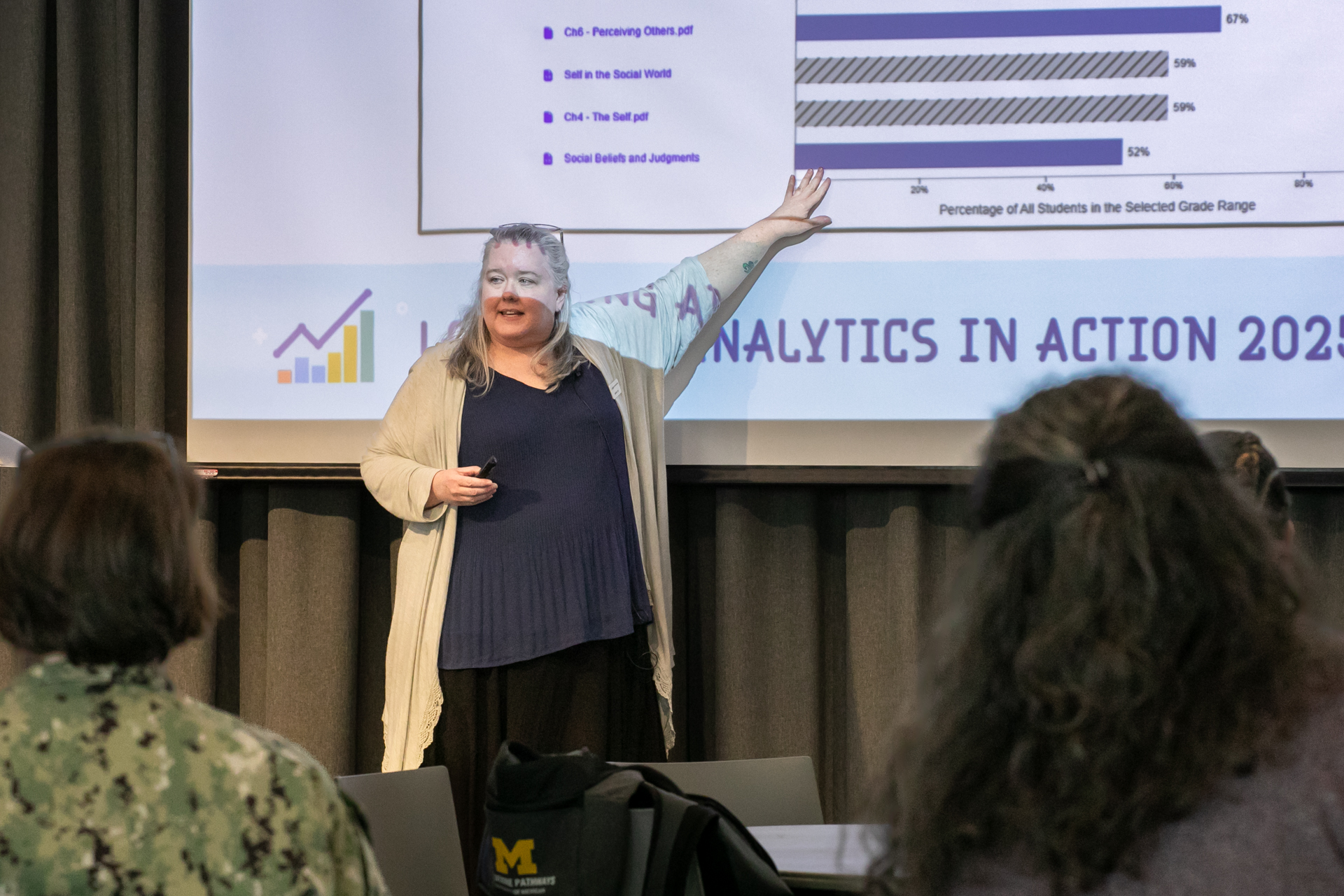
In April, the Teaching & Learning team hosted the inaugural ‘Learning Analytics in Action 2025: Enriching Your Teaching with Data’ event, a comprehensive showcase of how the effective use of data can transform classrooms and enhance student success. Teaching & Learning provided a full day of presentations and use cases to over 75 faculty, instructional staff, advisors, and other interested parties. Participants discovered how Canvas, MiVideo, Annoto and other available learning tools can offer a wealth of valuable insights into student engagement and performance. Attendees were able to learn from a broad spectrum of U-M educators and came away from the event with practical techniques to incorporate into their classrooms and daily workflows.
Testamonials
“I am so excited to figure out how to use MiVideo and Annoto! I use videos in my Canvas course, but until this session, I had never heard of MiVideo or Annoto…”
“I was already familiar with [Student Success Viewer], but not actively using it. I got exactly the nudge I needed to hop in… Super valuable tool for me as an advisor.”
“[My Learning Analytics] was completely new for me and really interesting!”