
FY2025 Accomplishments
The Administration and Operations team within Information and Technology Services worked diligently in the background to set the rest of the organization up for success. From the marketing and communications to the security hardening of systems throughout the university, the Administration and Operations team has continued to be the backbone of ITS.
Marketing and Communications
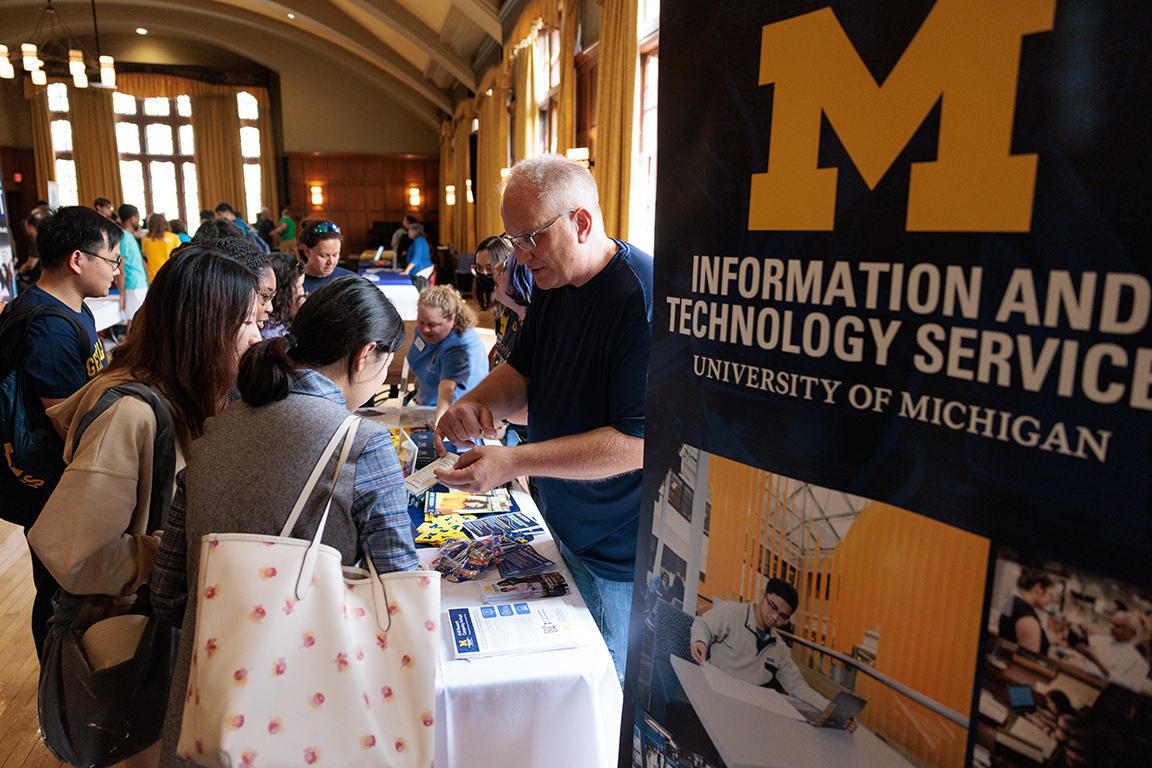
ITS Marketing and Communications supported dozens of project communications across the student, faculty, staff, and alumni communities, including service launches and retirements. They also led the campus-wide rollout of the Go Blue AI App. The team produced high-impact events such as Welcome to Michigan, Festifall, Researchpalooza, end-of-semester Power Up celebrations, New Faculty Orientation, and multiple GenAI showcases. They spearheaded the development and launch of the Digital Accessibility Strategic Initiatives’ communication strategy across all U-M campuses. Finally, they created an AI disclosure statement to ensure transparency for all ITS-produced content.
Facilities
The ITS Facilities team completed a series of strategic infrastructure improvements to modernize and future-proof key campus spaces. They oversaw a comprehensive renovation of the third floor of the Academic Services Building (ASB) and relocated the MiWorkspace Depot from the Central Student Services Building into ASB for improved accessibility. At Arbor Lakes, they replaced the roof of Building 2 and upgraded card readers to enhance building security. These projects ensure ITS facilities remain innovative, secure, and aligned with U-M's commitments to sustainability and user experience.
System Operations
The ITS System & Operations teams delivered several high-impact infrastructure and innovation milestones. The Server Virtualization team deployed a redundant virtual cluster within the Virtualization Service, empowering the Networking team to monitor U-M Net campus network more nimbly and comprehensively. The Virtual Desktop Infrastructure team built and launched a FIPS-compliant MiDesktop cluster for the Inter-University Consortium for Political and Social Research, ensuring sensitive data is protected with NIST-approved cryptographic standards. And the Cloud Services team collaborated with Google’s Rapid Innovation group, Nerdery, and Ross School of Business professors to pilot a Virtual Teaching Assistant: an AI chatbot powered by Google’s Gemini, deployed via Terraform, secured with new domain and certificate management, and balanced through a cross-project load balancer. This innovative service — set to expand to 9,000 students across 72 courses and 26 institutions over the next two years — demonstrates ITS’s commitment to leveraging cutting-edge cloud and AI technologies to enhance teaching and learning.
Core Applications Team
The ITS Core Applications team transformed ITS monitoring, service delivery, and security. The team migrated all Nagios users to a fully prepared Zabbix service — retiring legacy tooling while enhancing monitoring coverage — and simultaneously rolled out expanded customer self-service capabilities. Behind the scenes, the group boosted database performance to eliminate capacity bottlenecks, instituted standardized change-control processes, and reviewed the disaster-recovery plan to ensure resilience. In partnership with the PMO, the team integrated the Major Incident group into OpsGenie for streamlined alerting, launched a Service Center CTOP internship to share expertise and accelerate ticket resolution, and fortified email hosts by blocking malicious connections. Finally, the group deployed an ITAR-compliant GitHub instance to support export-controlled development environments, securing the university’s most sensitive codebases.
System Operations Storage Team
The ITS System Operations Storage team capped off FY25 by completing a landmark migration of over 5 petabytes of data — including more than 700 file shares — from legacy Isilon arrays to the high-performance VAST platform, a painstaking effort carried out during nights, weekends, and early mornings since October 2023 and finalized in March 2025. In February 2025, the team also rolled out MiBackup 2.0, combining on-premises disk arrays for rapid, reliable backups with Amazon Cloud Storage for cost-effective long-term retention — significantly enhancing the university’s data resilience, performance, and scalability.
Linux Team
The ITS Linux team significantly bolstered the university’s cybersecurity and operational efficiency by rolling out an automated, monthly security-patching framework across all managed Linux servers. This proactive approach not only ensured that critical updates and vulnerability fixes were applied consistently and on schedule, but also freed system administrators from manual patching tasks — streamlining workflows, reducing human error, and strengthening the university’s overall security posture.
MiServer and MiDatabase
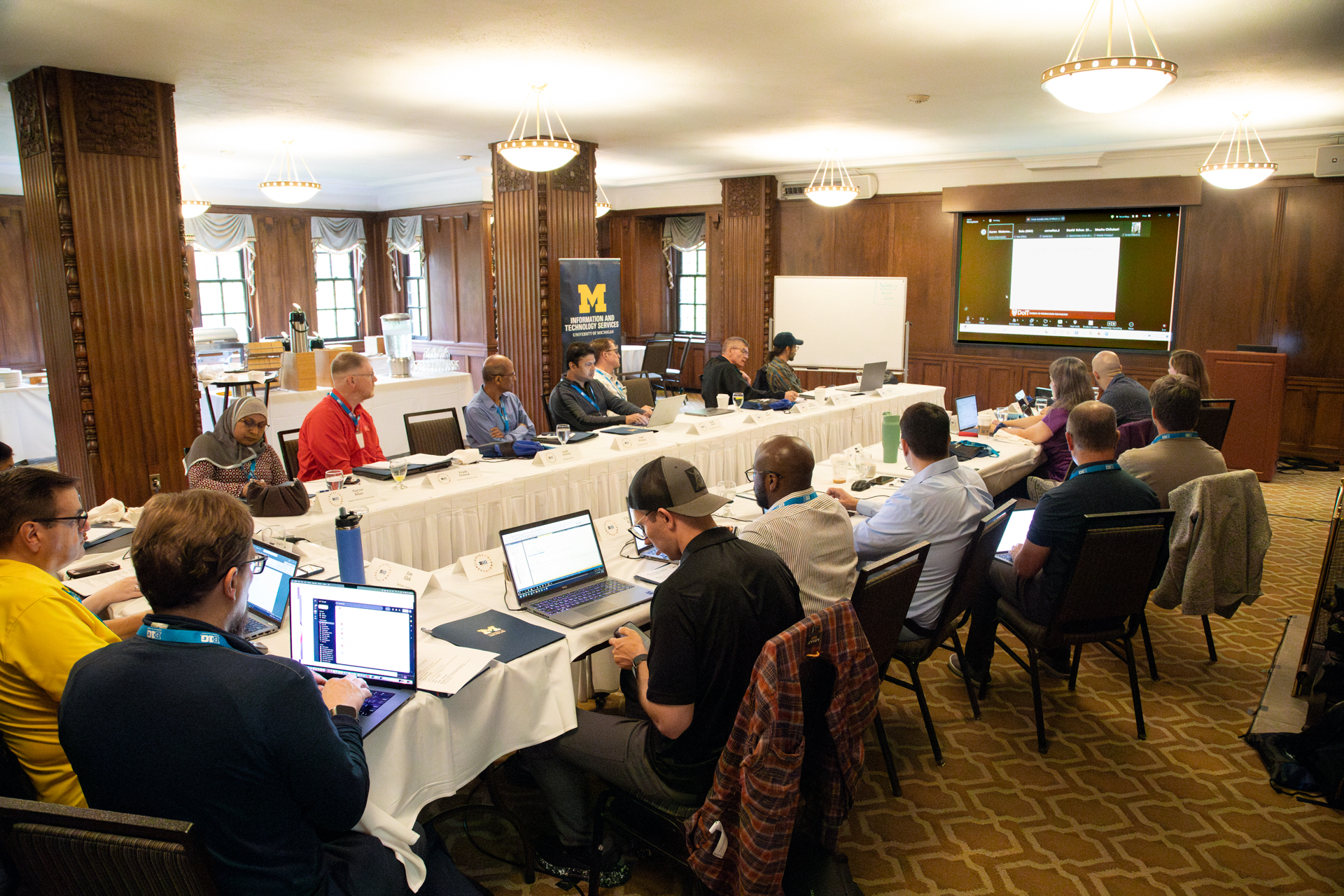
The ITS MiServer and MiDatabase team successfully upgraded over 100 MiDatabase servers from MySQL 5.7 on RHEL 7 to MySQL 8.0 on RHEL 8 — collaborating with individual application owners to ensure full compatibility and minimizing downtime through robust database replication — while also hosting the BTAA DBA conference in May to foster community engagement among database professionals. In parallel, the team modernized its MiServer Windows Server Security Standards by introducing automated update hardening on all newly managed systems (with a retrofit approach for existing servers) and streamlining policy enforcement and vulnerability management. This initiative drove compliance to over 90% against both CIS-CAT and DoD STIG level 1 and 2 benchmarks — well above the original 80% target — thereby solidifying a stronger, more transparent security foundation.
Organizational Development Team
The ITS Organizational Development team achieved Qualified Education Provider status for its Organizational Change Management (OCM) training — enabling certification candidates to save up to $4,500 — while introducing team-building, change-management, and facilitation services alongside networking events to strengthen performance and connectivity across units. They also launched an “OCM Backstage” toolkit page to support individuals navigating the people-side of change, and debuted five professional development courses — OCM Levels 1–3, Communicating Effectively (Straight Talk), Crucial Conversations for Accountability, Crucial Influence, and Giving & Receiving Feedback — all of which garnered satisfaction ratings between 85% and 100%.
Finance Accomplishments
With a $159 million budget, the ITS Finance team helped launch AI capabilities through financial modeling, establishing billing procedures for ITS with this innovative technology. The team created a TeamDynamix financial billing portal for ITS Recharge Rates, which accounted for approximately $31 million in FY25 billings. They also managed financial aspects for major incidents and future planning needs. In FY25, the Finance team also saw the completion of several major projects, including the ARC Research Computing Support & Data Center Upgrade project: a 7 year, $30 million capital project; and the Digital Asset Management Project: a 2 year, $1 million capital project. These projects are being wrapped in the FY25 budget, accounting for some of the $157 million in actual costs, $2 million better than the budget.
HR Accomplishments
The ITS Human Resources team saw growth and retention in FY25. The HR team hired more than 60 new staff, supported 20 staff retirements, and maintained a 91% retention rate. A part of that effort was revamping and relaunching the ITS HR Orientation for new employees, creating and facilitating the new annual Performance Management training, and refining the immigration policies for ITS recruitment procedures. Current employees can participate in the Change Management job series at the university since HR’s partnership with the Compensation and Classification team.