
FY2026 Accomplishments
Expanding AI Across the University
In FY26, Information and Technology Services (ITS) continued to expand the University of Michigan’s leadership in applied artificial intelligence. Building on an established foundation of secure, institutionally supported AI services, the Emerging Technology team focused on helping the university community move from exploration to practical, everyday use of AI.
This work reflects a broader shift in how AI is being adopted at Michigan. Rather than isolated experimentation, faculty, staff, and students are increasingly integrating AI into teaching, research, and operations in ways that improve efficiency, enhance learning, and support new forms of discovery.
Strengthening Core AI Platforms
U-M GPT remains a cornerstone of the university’s AI ecosystem by providing secure, no-cost access to leading models. Over the past year, the platform has been enhanced with expanded capabilities, which include improved file handling, image generation, and access to a wider range of models. In December 2025, U-M GPT was approved for use with PHI (Protected Health Information), which greatly increased its capabilities for users at Michigan Medicine by providing a secure AI platform to meet their needs. These updates culminated in an upgrade to GPT-5.5, which strengthens performance across writing, analysis, and problem-solving tasks and supports more consistent, reliable outcomes.
These enhancements have reinforced U-M GPT as a trusted, flexible platform that supports a wide range of academic and administrative needs while maintaining a strong commitment to privacy and data protection.
Advancing the Maizey Platform
The Maizey platform continued to evolve as a central tool for customized AI experiences at Michigan. Maizey was approved for appropriate uses involving PHI and gained conversational memory, deeper Canvas integration, and more context-aware interactions.
More recently, Maizey introduced a new “Apps” architecture, which allows users to create multiple tailored AI tools from a single dataset. This shift supports more targeted and effective applications of AI by enabling faculty and staff to design tools that meet the specific needs of different audiences and use cases.
Together, these advancements position Maizey as a flexible platform for building practical, domain-specific AI solutions across the university.
Introducing Agentic AI Capabilities
During this period, ITS introduced new capabilities that move beyond content generation and toward action-oriented AI.
AI Workflows, a new low-code platform, enables faculty and staff to automate multi-step processes by connecting systems, data, and AI. These workflows can gather information, make decisions, and take action while incorporating human review when needed. This approach improves efficiency and consistency across both routine and complex tasks.
In parallel, Claude Code was introduced through the U-M GPT Toolkit, which expanded its support for software development and technical workflows. This AI coding assistant can read and edit code, generate tests, and assist with debugging and feature development within a secure, university-managed environment.
These capabilities reflect a growing focus on agentic AI, where tools are designed not only to generate outputs, but to help complete work.
Building AI Literacy and Community Engagement
A key priority for the Emerging Technology team has been ensuring that the university community is prepared to use AI effectively and responsibly.
Through hands-on workshops such as the “Make a Maizey” series, faculty and staff have learned how to build custom AI tools using their own data. These sessions, along with expanded training offerings and self-paced resources, have reached thousands of participants and helped translate AI concepts into practical applications.
Engagement has continued to grow across the university, with increasing participation in workshops, courses, and collaborative learning opportunities focused on generative AI.
Growing Demand for Applied AI
The strong interest in applied AI has been reflected in high-demand events and programming across campus.
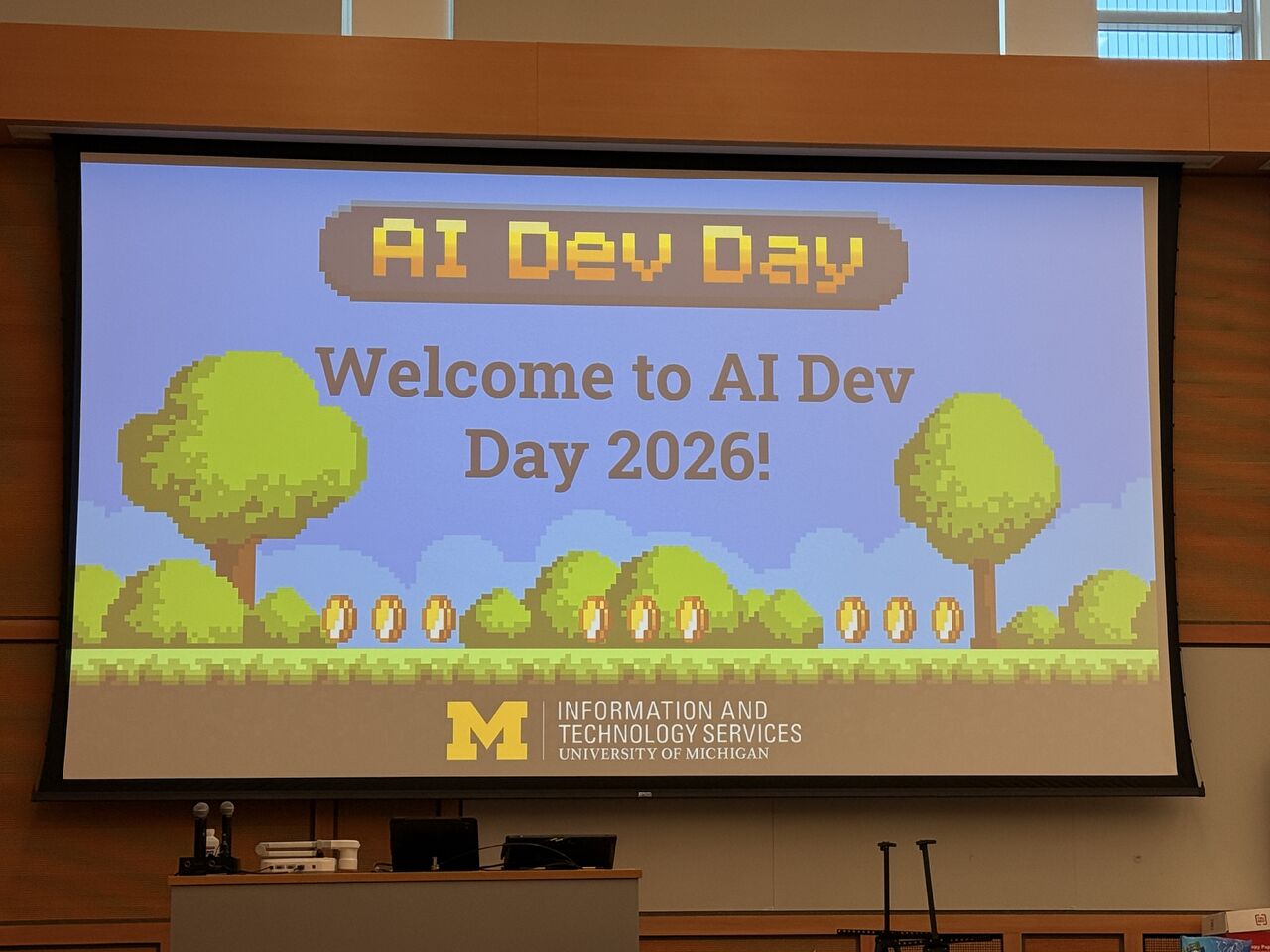
AI-focused sessions, including a Dev Day deep dive on AI Workflows, filled quickly and reached capacity, which demonstrates the community’s enthusiasm for learning how to apply AI in meaningful ways. Participants moved beyond learning concepts to actively building and testing solutions in an increasing shift towards real-world implementation.
This momentum highlights a growing expectation that AI tools will play an integral role in how work gets done across the university.
Advancing AI Responsibly
Across all of these efforts, ITS has maintained a strong focus on responsible AI adoption.
University-supported AI services are designed to be secure and private by default, which ensures that institutional data is protected and not used to train external models. At the same time, ITS continues to emphasize equitable access by making advanced AI tools that are compliant with WCAG 2.1 AA web accessibility guidelines available to the entire university community at no cost.
This balanced approach enables innovation while reinforcing the university’s commitment to ethical and responsible use of emerging technologies.
Looking Ahead
The past year represents a meaningful step forward in the university’s AI journey. With continued investment in platforms, tools, and community engagement, Michigan is moving beyond early adoption toward sustained, institution-wide impact.
As these capabilities continue to evolve, ITS will remain focused on supporting practical, responsible uses of AI that enhance teaching, accelerate research, and improve the way the university operates.