
Schedule and Roadmap
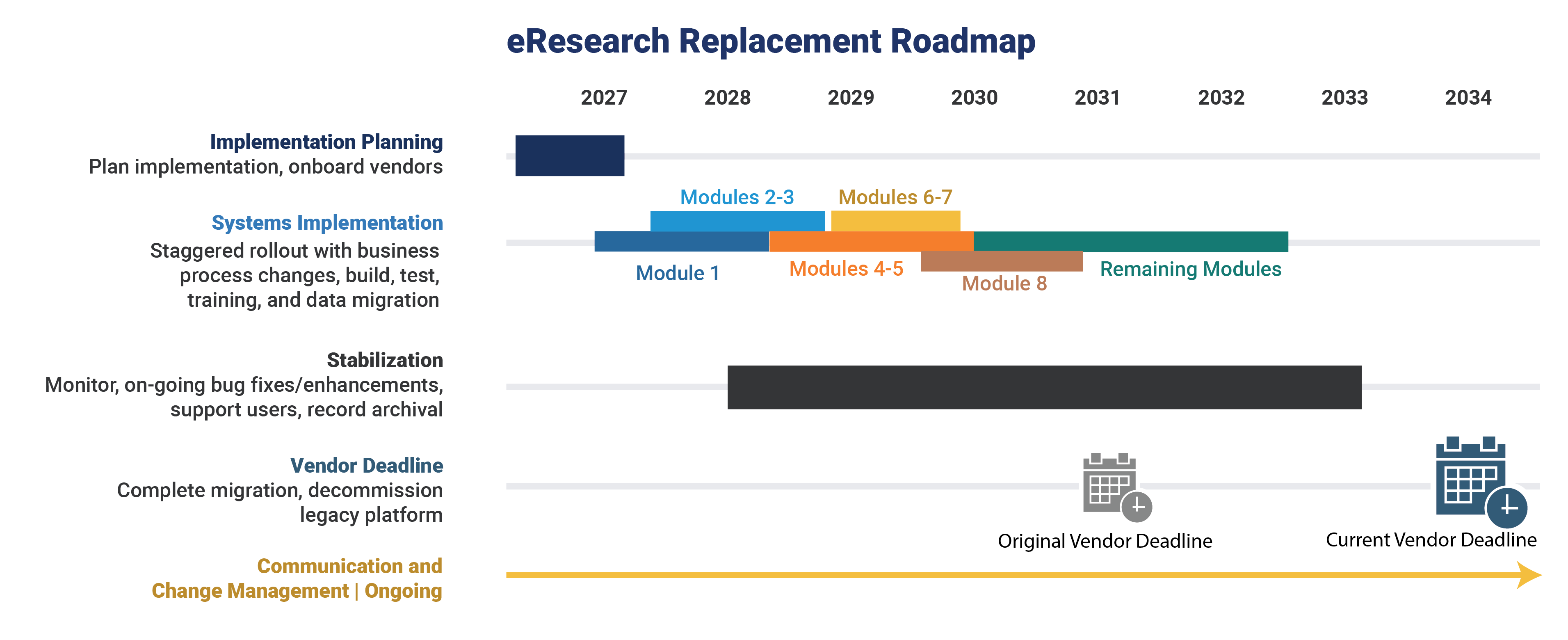
Communication and change management is ongoing, and throughout these phases, the university community will have opportunities to provide critical input.
Note: This roadmap reflects current plans and is subject to change.
- Modules are groups of related system functions and processes—such as COI, IACUC, IRB, and Proposals and Contracts—that will be introduced in phases. The sequence of implementation has not yet been determined.
- We expect most critical functions to be completed by the original 2031 deadline. However, some modules developed collaboratively by U-M and the new vendor may require additional time. We may also add or update features and modules to meet changing regulatory requirements before the project is completed and moves into ongoing operations.
Request for Proposal 2026
Issue Request for Proposals, Negotiate Contracts
U-M will conduct a competitive bid process to evaluate, select, and negotiate contracts with a new research administration software provider, and potentially system implementers or other consultants. The RFP process will include hands-on evaluations/proofs-of-concept with finalists. There will be opportunities to review vendors, provide insights, and share feedback in the selection process throughout the year.
Implementation Planning 2027
Plan implementation, Onboard Vendors
Once vendors are selected, U-M will work closely with them to develop an overall onboarding plan and strategy to migrate our current products to new platforms. This will include integrating U-M and vendor project teams, as well as developing a more detailed implementation timeline.
Systems Implementation 2027–2031
Staggered rollout with business process changes, build, test, training, data migration
We anticipate a staggered rollout of the eResearch modules, starting with detailed designs, business process mapping reviews, and modifications to set up our workflows in the new systems. Implementation will include time for testing, training, data migration, and feedback cycles ahead of each launch. We anticipate legacy systems will remain available concurrently in this phase, and systems to access historical data will be made available.
Stabilization 2028–2033
Monitor, ongoing fixes, enhancements, support users, record archival
Our target is to complete migrations to new systems ahead of the vendor's end-of-support deadline with minimal disruption to ensure business continuity and continuous support. Once stabilized, we will decommission legacy systems and continue to provide access to historical data.
Vendor Deadline 2034
Complete migration, Decommission legacy platform
Our target is to complete migrations to new systems ahead of the vendor’s end of support deadline to ensure business continuity and continuous support. Once stabilized, we will decommission legacy systems and continue to provide access to historical data.
Pre-Planning Completed
Planning Project 2024–2025
Recommend path forward, request funding, identify resources
Two-year planning effort and discovery phase engaged with key campus research administration partners to document eResearch system functionality and business requirements, explore the current research administration software market, participate with community and advisory groups, benchmark with higher education and R1 peer institutions, conduct a fit-gap analysis based on requirements and initial vendor demonstrations, and develop a recommendation for how U-M will move forward to complete migrations by the deadline.
High-level accomplishments:
- Campus Survey Results
- Conduct an RFI
- Commission the Steering Committee to guide decisions through the RFP phase
- Kick off data strategy workstream
- Submit IT Capital Request